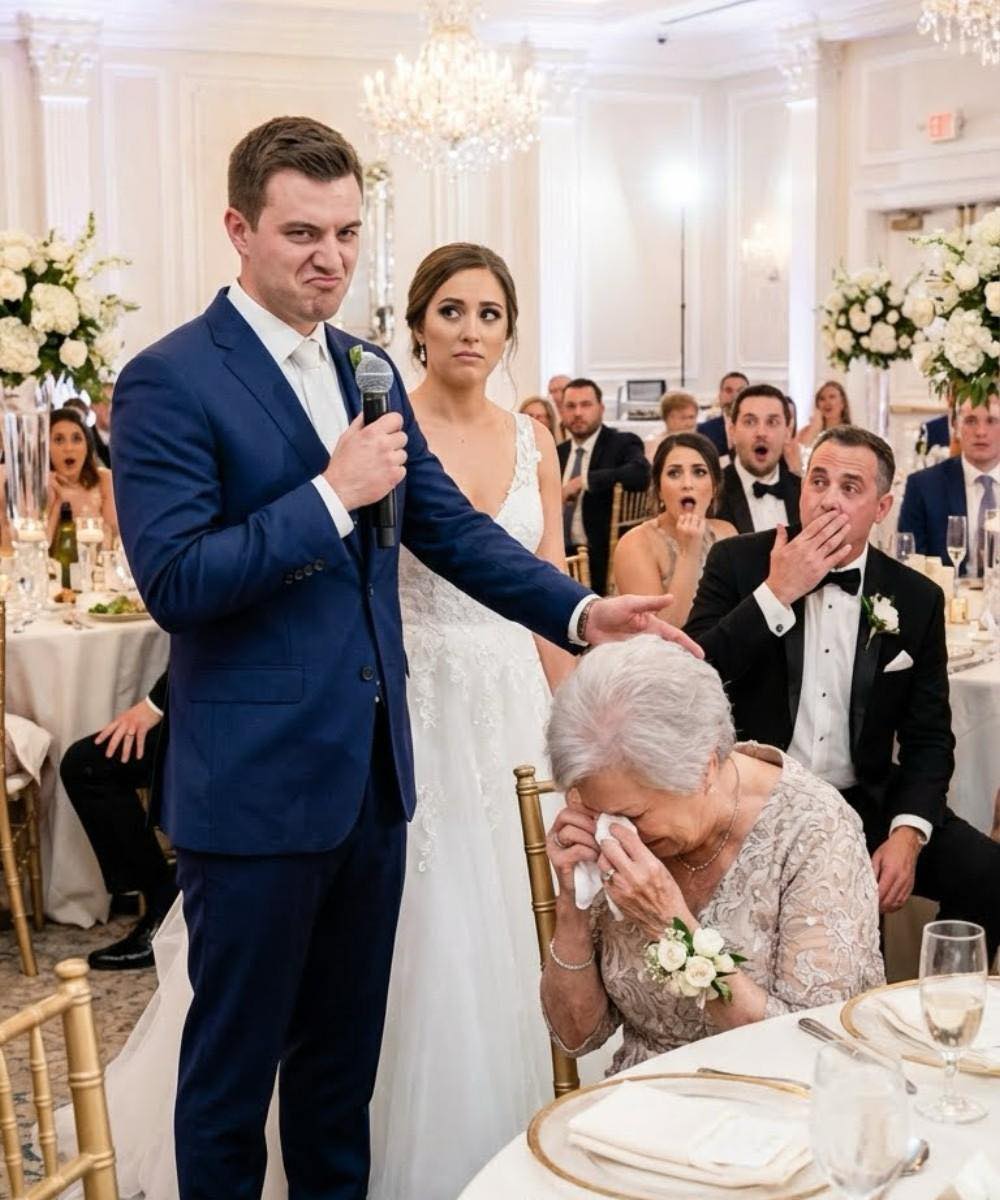
Ogni centesimo che avevo risparmiato in una vita di lavoro, sacrifici e privazioni. Mi sono detta che era un ultimo regalo. Un ultimo atto d’amore prima di ritirarmi silenziosamente in secondo piano nella sua vita da adulto.
Invece, l’ho visto cancellarmi davanti a duecento persone.
Mi chiamo Stephanie. Ho settant’anni. E per quarantacinque anni sono stata la madre di Ethan in ogni senso importante.
L’ho adottato quando aveva cinque anni. È arrivato da me piccolo e silenzioso, con occhi che sembravano molto più vecchi del suo corpo. Si svegliava urlando quasi tutte le notti, chiamando genitori che non sarebbero mai tornati. Ho imparato in fretta a sedermi sul bordo del letto alle tre del mattino e a sussurrargli parole di conforto finché non smetteva di tremare.
Non mi sono mai risposata. Non ho mai avuto altri figli. La mia vita si è volontariamente ridotta a lui. Ho fatto due lavori. Ho rinunciato alle vacanze. Ho riposto i miei sogni in un cassetto e mi sono detta che amarlo era sufficiente.
Per decenni, lo è stato.
Ma l’amore cambia forma quando smette di essere ricambiato.
Ethan ha conosciuto Ashley tre anni fa. Fin dall’inizio, lei mi ha guardato come si guarda un fastidio che si vorrebbe veder sparire silenziosamente. Era gentile a parole, tagliente nel tono e sprezzante in un modo che non lasciava traccia.
Sua madre, Carol, era tutt’altro che discreta. Parlava a voce alta di eventi di beneficenza, proprietà e conoscenze. Si assicurava che tutti sapessero esattamente qual era il suo posto nel mondo. E, al contrario, si assicurava che io sapessi qual era, secondo lei, il mio posto.
Ero solo la donna anziana che lo aveva cresciuto. Una soluzione temporanea. Il passato.
Lentamente, Ethan iniziò a cambiare.
Le telefonate si fecero più brevi. Le visite più rare. Quando mi abbracciava, mi sembrava un gesto frettoloso, quasi un obbligo. Più la sua vita si faceva impeccabile, più sembrava a disagio con la donna che gli aveva dato tutto.
Poi, un pomeriggio, venne al mio appartamento e si sedette sul divano come un uomo che consegna una bolletta.
“Abbiamo bisogno di soldi per il matrimonio”, ha detto.
Niente cedimento. Nessuna esitazione.
«Quanto?» chiesi, pur sapendo già che la risposta mi avrebbe ferito.
“Diciannovemila dollari.”
Lo disse come se niente fosse. Come se fosse scontato.
«Questo è tutto ciò che ho», sussurrai.
Non ha battuto ciglio.
«Se mi amassi», disse, «non esiteresti».
Qualcosa dentro di me si è spezzato silenziosamente. Ma sono andato comunque in banca. Ho svuotato i miei risparmi e gli ho consegnato l’assegno.
Non mi ha abbracciato.
Non mi ha ringraziato.
Ha semplicemente detto: “Ashley apprezzerà questo gesto”.
I mesi successivi mi hanno spogliato pezzo dopo pezzo.
Ashley ha controllato ogni dettaglio del matrimonio, compresa la mia posizione nelle foto e il mio posto a sedere. Una volta, quando il fotografo mi ha avvicinato, è intervenuta prontamente.
«Non così vicino», disse lei. «Rovina l’effetto.»
Ethan non disse nulla.
When I asked if I could invite three women from work who had helped me survive the hardest years of motherhood, Ashley wrinkled her nose.
“This is a very elegant event,” she said. “We don’t want anything tacky.”
The women who had held my hand through exhaustion and grief were not good enough for the wedding I was paying for.
Still, I told myself this was temporary. That once the wedding passed, my son would remember who I was to him. Who I had always been.
On the wedding day, I arrived early in a coral dress I had chosen carefully. It made me feel warm. Alive. Visible.
Ethan looked at me once.
“Do you have something more subtle?” he asked. “I don’t want people staring.”
Shame burned up my neck. But I stayed quiet. Because somewhere inside me, the memory of a frightened five year old boy still held power.
The ceremony was beautiful. Sunlight. Flowers. Soft music. I cried quietly when he said his vows, remembering the child who used to cling to my leg in grocery stores.
I did not know what was coming.
At the reception, Ethan took the microphone for his speech. He smiled toward Ashley’s family. Confident. Comfortable.
Then he said it.
“I want to thank my real mother.”
The room froze.
He raised his glass and turned toward Carol.
Applause followed. Loud. Enthusiastic.
People looked at me. Some with pity. Some with confusion. Some with judgment.
I sat perfectly still, smiling the way women learn to smile when their hearts are breaking quietly.
He did not look at me once.
And in that moment, sitting at a table I paid for, watching a son I raised hand his gratitude to someone else, something inside me changed forever.
I said nothing.
But I decided everything.
Carol came to my table later with a syrupy smile.
“What a lovely ceremony,” she said. “Thank you for everything you did when Ethan was little. We’ll take it from here.”
Her words landed like a final dismissal. As if my role had expired.
Ethan stopped by briefly.
“Wasn’t my speech moving?” he asked.
Ashley clung to his arm, glowing.
“My mom is planning a three week honeymoon in Europe for us,” she said excitedly. “Isn’t she incredible?”
I nodded politely while my bank account sat empty.
Around midnight, I left quietly. Ethan barely noticed.
“Thanks for coming,” he said.
Ashley stopped me at the door.
“We’re looking at houses after the honeymoon,” she said. “We know you have more savings.”
I told her I had spent everything.
She smiled.
“A woman your age doesn’t need much money,” she said. “Think of it as an investment.”
That night, I sat alone in my apartment, still wearing my coral dress, surrounded by photos of a life that suddenly felt like a lie.
The next morning, Ethan called.
“We’ll need help with the house,” he said. “It’s time you showed how much you love me.”
When I reminded him I had nothing left, he sighed.
“Don’t be dramatic.”
The line went dead.
That was the moment I stopped being silent.
I went to my bedroom and opened a drawer I hadn’t touched in years.
And everything changed.
I went to my bedroom and opened the dresser drawer I hadn’t touched in years.
At the very bottom, under old scarves and a few yellowed envelopes, was a plain folder wrapped in a rubber band. No fancy label. No dramatic markings. Just paperwork I had kept private for decades, the way you keep something private when you’ve spent a lifetime learning that the wrong people treat money like permission.
My hands shook as I pulled it out, not because I was frightened, but because I finally understood something that should have been obvious long ago.
Ethan did not see me as a mother.
He saw me as a resource.
And if a person treats you like a resource, you have to start thinking like a grown woman with estate planning responsibilities, not like a mother begging for crumbs of affection. In that moment, the words “retirement planning” stopped being a category on a brochure and became my lifeline.
I sat on the edge of my bed and opened the folder.
Inside were certificates of deposit, property paperwork, statements from investment accounts, and documents from my father’s estate. I had never used these things to impress anyone. I had never even mentioned them, not to coworkers, not to friends, and certainly not to Ethan. I lived in my modest apartment because it made life simpler. It kept people honest. It kept me safe.
But honesty was gone now anyway.
I flipped through the pages slowly, letting the reality settle into my bones. I had assets. Real assets. The kind that can protect you in old age and give you options when the world tries to corner you.
Ethan had just spent nineteen thousand dollars of my life savings on a wedding that treated me like an inconvenience.
He had no idea what I actually had.
And for the first time since Julie, since childhood, since all the years of swallowing disappointment, I felt something that surprised me.
Calm.
Not bitter calm. Not numb calm.
Clear calm.
Because now I knew exactly what I had to do.
The Call I Had Kept in My Contacts for Years
I walked into the kitchen, poured myself a glass of water, and stared at the phone like it might bite me. My reflection in the dark window looked older than it had yesterday. Not because of wrinkles. Because something inside me had finally stopped hoping.
I scrolled through my contacts until I found the name I hadn’t used in years.
Miller Law Office.
I had met Mr. Miller when my father passed away. My father was the kind of man who worked hard, kept his mouth shut, and made careful moves. He bought cheap land on the edge of town when nobody wanted it. He invested slowly. He thought ahead. He wasn’t flashy, but he was smart.
And when he died, he left me more than money.
He left me a lesson.
I called the office first thing that morning.
“Law office of Miller,” a receptionist answered.
“This is Stephanie Herrera,” I said. “I need an appointment. It’s urgent. It involves my estate planning and my will.”
There was a pause, then a softer tone. “Of course, Mrs. Herrera. Let me see when Mr. Miller is available.”
When I hung up, I stood in my quiet apartment and looked at Ethan’s childhood photos on the wall. Birthday cakes. School plays. Holiday mornings. Me smiling behind him like I was proud to be invisible as long as he was happy.
I wasn’t proud anymore.
I was awake.
Walking into the Office Like a Different Woman
Three days later, I stepped into Mr. Miller’s office wearing a navy coat and my most sensible shoes. Not because I was trying to impress him, but because I wanted to remind myself that I still had dignity.
Mr. Miller came out to greet me, elegant and professional, the kind of man who looked like he belonged in any room.
“Mrs. Herrera,” he said warmly, shaking my hand. “It’s been a long time.”
“It has,” I replied. “And I need you to help me make some changes.”
He gestured toward a chair across from his desk. The surface was polished, uncluttered, and expensive, like the kind of desk that belongs to someone who has never had to choose between rent and groceries.
I sat down anyway, steady as I could manage.
“I want you to review all my assets,” I said. “Everything. Properties, investment accounts, insurance policies, and any updated paperwork from my father’s estate.”
Mr. Miller nodded, pulled out a thick file, and began turning pages with the careful attention of someone who understands that numbers tell stories.
As he read, I watched his expression shift. Not into shock, exactly. More like confirmation.
“Your father planned well,” he murmured. “And you’ve managed this responsibly.”
He tapped a page with his pen, then looked up at me.
“You currently hold multiple properties and investment accounts,” he said. “Total estimated net worth is approximately eight hundred forty thousand dollars.”
Even though I already knew, hearing it out loud tightened something in my chest.
Eight hundred forty thousand.
Ethan had treated me like a burden over nineteen thousand.
I leaned forward slightly.
“Mr. Miller,” I said, “I want to update my will. Immediately.”
He studied my face. “Of course. May I ask why?”
“Because my son announced at his wedding that someone else is his real mother,” I replied. “And then he asked me for more money the next day. I need my retirement planning to reflect reality, not fantasy.”
Mr. Miller took a slow breath and nodded.
“All right,” he said. “Tell me what you want.”
The Decision That Felt Like Air Returning to My Lungs
I had thought I would cry when I said it out loud.
I didn’t.
“I want to remove Ethan as the beneficiary,” I said, keeping my voice even. “I want my assets redirected into a charitable foundation for women who adopt children and raise them without support.”
Mr. Miller’s eyebrows lifted. Not judgmental. Just surprised.
“That is a significant change,” he said carefully. “Are you certain?”
“I am certain,” I answered. “If I am not his mother, then he is not entitled to inherit from me as if I were.”
Mr. Miller nodded and began writing.
“Do you want to leave him anything at all?” he asked, professional but gentle.
I thought for a moment. It wasn’t that I wanted to be harsh. It was that I wanted to be accurate.
“Leave him a letter,” I said. “A formal notice. Let him know the truth. Let him understand that this is not a tantrum. It is an outcome.”
Mr. Miller wrote more notes.
“And I want an updated power of attorney and health directive,” I added. “I want to choose who makes decisions for me if I ever cannot.”
His pen paused.
“Not your son?” he asked, quietly.
I shook my head.
“Not my son,” I said. “He has proven he will choose what benefits him, not what protects me.”
Mr. Miller leaned back in his chair, then nodded slowly.
“Understood,” he said. “We will put everything in order.”
When I walked out of his office that day, something strange happened.
I felt lighter.
Not because I was celebrating anything. But because I was no longer pretending.
The Apartment I Had Outgrown Without Realizing It
On the way home, I drove past buildings I had always considered “for other people.” Sleek glass towers. Doormen. Lobbies that smelled like flowers instead of cleaning supplies.
A thought came to me, so simple it made me laugh once, quietly, in the car.
Why am I still living like I’m waiting to be invited into my own life?
That afternoon, I visited one of my properties downtown. An office building with a manager I rarely bothered. Mr. Evans greeted me like I was royalty.
“Mrs. Herrera,” he said. “It’s an honor. Is everything all right?”
“I’d like to see the top floor unit,” I said. “The penthouse.”
His eyes widened. “Of course.”
We rode the elevator up in silence. The doors opened into a space that took my breath away. Sunlight. Windows that stretched from floor to ceiling. A terrace with a view of the city that looked like a painting.
“This unit has been listed for rent,” Mr. Evans said. “It’s premium.”
I walked slowly through the rooms, touching the counter, looking out at the skyline, feeling the quiet luxury of a space that didn’t apologize for existing.
“Cancel the listing,” I said.
Mr. Evans blinked. “Ma’am?”
“I’m moving in,” I told him.
He hesitated, then smiled politely as if he still wasn’t sure this was real.
“Mrs. Herrera,” he said carefully, “this is a high-end property. The monthly rate is significant.”
“I’m not asking you for the rate,” I replied. “I’m telling you my decision.”
My voice didn’t shake.
That was new.
The First Phone Call That Didn’t Feel Like Begging
The next day, moving trucks arrived at my small apartment. I watched men carry boxes past the framed photos of Ethan, past the little signs of a life I had built around him.
I didn’t take everything.
Some memories stay. Some you put away.
While the movers worked, my phone rang.
Ethan.
I stared at his name on the screen for a moment before answering. I wanted to hear his voice. I wanted to hear what kind of concern he had. If it was real concern, it would sound different.
“Mom,” he said immediately. “What’s going on? I went by your apartment and there are trucks outside.”
I kept my voice calm.
“I’m moving, Ethan.”
“Moving where?” he demanded. “Why didn’t you tell me?”
I almost laughed. Not because it was funny. Because it was revealing.
“I didn’t think it was necessary,” I replied. “After all, you made it clear at your wedding that I’m not your real mother.”
A long silence filled the line.
“Mom, don’t be dramatic,” he finally said. “You know I love you. Carol is just like a second mother.”
Second mother.
He said it like he was trying to soften the insult with vocabulary.
I felt something settle in my chest, heavy and final.
“If you need to reach me,” I said, “contact Mr. Miller. He has my updated information.”
His voice sharpened. “Why do you have a lawyer?”
“I’m putting my affairs in order,” I replied. “That’s what responsible people do.”
He sounded uneasy now. “Mom, you’re scaring me.”
I didn’t raise my voice. I didn’t argue. I just told the truth.
“You should be scared,” I said softly. “Not of me. Of what you’ve chosen to become.”
Then I ended the call.
The Quiet Victory That No One Could Take
That evening, I stood on the terrace of the penthouse and watched the city lights come on one by one. The air felt different up there. Cleaner. Cooler. Like a fresh start.
For the first time in decades, my life belonged to me.
No waiting for Ethan to remember me.
No swallowing insults from Ashley.
No nodding politely while Carol talked to me like I was a retired employee being thanked for past service.
I poured myself a glass of wine and sat down in the quiet.
Then my phone rang again.
Unknown number.
When I answered, a voice I recognized immediately came through, tight and controlled.
“Stephanie,” Carol said. “We need to talk.”
I smiled at the dark sky.
It was starting.
Carol arrived at my building less than two hours later.
The doorman announced her name with the same polished tone he used for every resident, but I could hear the hesitation underneath it. People like Carol were used to being welcomed on their own terms. Being announced was new for her.
I let her come up.
The elevator doors opened onto my floor, and she stepped out alone. No Ashley. No Ethan. Just Carol, dressed impeccably, holding a designer handbag like armor.
She took one step into my apartment and stopped.
The view hit her first. The glass walls. The city lights. The terrace that wrapped around the space like a promise. This was not the home of a helpless retiree.
“This is… very nice,” she said carefully.
I gestured toward the sofa. “Please, sit.”
She didn’t sit right away. She walked slowly through the living room, touching nothing, observing everything. When she finally turned back to me, the smile she offered was entirely different from the one she wore at the wedding.
Measured. Cautious.
“Stephanie,” she began, “I think there’s been a misunderstanding.”
I let a few seconds pass before responding.
“There was no misunderstanding,” I said calmly. “There was a declaration. My son made it.”
She sat down then, smoothing her skirt. “Ethan was emotional. Weddings are overwhelming. He didn’t mean to hurt you.”
“Carol,” I replied, “my son did not forget my name. He chose to replace me.”
Her lips pressed into a thin line.
“You must understand,” she continued, “Ashley comes from a different world. Ethan wanted to feel accepted. He wanted to belong.”
I laughed softly, the sound surprising even me.
“He already belonged,” I said. “He just decided my world wasn’t impressive enough.”
Carol leaned forward. “Stephanie, we are family now. There’s no reason to turn this into something permanent.”
“Permanent?” I echoed. “This wasn’t sudden. This was years in the making.”
She sighed, switching tactics. “Ethan is devastated. He’s barely functioning. You raised him. You know he’s sensitive.”
I met her eyes.
“I know he’s entitled,” I said. “And I know who taught him that it was acceptable to erase people once they stop being useful.”
That landed.
Carol’s composure cracked just slightly. “What do you want?” she asked. “An apology? A statement? We can fix this.”
I stood and walked to the window, looking out at the city.
“I wanted respect,” I said. “Years ago. Quietly. Without conditions.”
She stood up as well. “And now?”
“Now I want peace.”
She exhaled sharply. “Stephanie, don’t be unreasonable. Ethan is your son.”
I turned back to her slowly.
“No,” I said. “He made it very clear who his real mother is.”
The silence stretched.
Finally, Carol spoke again, softer this time. “Ethan didn’t know about your finances. If he had—”
I cut her off.
“That is the point,” I said. “If love depends on knowing how much money someone has, it was never love.”
Her shoulders sagged.
“You’ve embarrassed our family,” she said quietly. “People are talking.”
I smiled faintly. “So they noticed.”
Carol stood abruptly. “You’re punishing him.”
“No,” I replied. “I stopped rescuing him.”
She stared at me for a long moment, then picked up her handbag.
“This isn’t over,” she said.
“It is for me,” I answered.
She left without another word.
The Apology That Came Too Late
Three days later, Ethan came.
Not announced. Not accompanied. Alone.
The doorman called to ask if I would allow him up.
I thought about the little boy who used to wait by the window when I came home from work.
“Yes,” I said. “Send him up.”
When the elevator doors opened, he looked smaller. Thinner. His shoulders were slumped, his eyes red and tired.
He stepped inside slowly, like someone entering a place they weren’t sure they were welcome.
“Mom,” he said.
I didn’t correct him.
“I’m sorry,” he said immediately. “I was wrong. I was stupid. I hurt you.”
I waited.
He swallowed hard. “I didn’t realize what I was doing. I thought… I thought you’d always be there.”
“There it is,” I said softly.
He flinched. “I didn’t mean—”
“You thought I was permanent,” I continued. “Unmovable. That I would always adjust, always forgive, always pay.”
Le lacrime gli riempirono gli occhi. “Non volevo cancellarti.”
«Ma l’hai fatto», ho risposto. «Pubblicamente. Di proposito.»
Fece un passo avanti. «Per favore. Farò qualsiasi cosa. Chiederò scusa pubblicamente. Taglierò i ponti con i miei suoceri. Io…»
Ho alzato delicatamente la mano.
«Ethan», dissi, «sai cosa fa più male?»
Lui scosse la testa.
«Hai capito il mio valore solo quando hai pensato di perdere qualcosa», ho detto. «Non io. I miei soldi. La mia sicurezza. La mia utilità.»
Allora scoppiò in lacrime, apertamente.
«Mi sbagliavo», sussurrò.
«Sì», dissi. «E sbagliare ha delle conseguenze.»
Mi fissò incredulo. “Stai davvero facendo questo? Stai scegliendo una fondazione al posto di tuo figlio?”
«Scelgo donne a cui non verrà mai detto che sono usa e getta dopo aver dedicato la propria vita a qualcun altro», ho risposto. «Scelgo il significato».
Si lasciò cadere sul divano.
“Non so come fare a vivere senza di te”, disse.
Ho sentito un barlume del vecchio istinto riaffiorare nel mio petto. L’impulso di confortare. Di aggiustare.
L’ho spinto verso il basso.
«Imparerai», dissi. «Nello stesso modo in cui ho imparato io.»
Alzò lo sguardo. “C’è qualche possibilità che tu cambi idea?”
Scossi lentamente la testa.
“Ethan, un amore che deve essere negoziato dopo decenni di sacrifici non è amore. È paura.”
Rimase in silenzio per lungo tempo, poi si alzò.
«Spero che tu sia felice», disse a bassa voce.
«Anch’io», risposi.
Se ne andò senza aggiungere altro.
La vita che mi sono costruita dopo aver lasciato il passato.
Mi sono trasferita a Barcellona due settimane dopo.
Non per fuggire. Per arrivare.
Il mio appartamento si affacciava sul Mediterraneo, immerso in una luce di cui avevo dimenticato l’esistenza. L’ho riempito di piante, libri, opere d’arte. Ho frequentato corsi di pittura. Ho fatto volontariato presso la fondazione che avevo creato, aiutando le donne che adottavano bambini e a cui veniva detto che avrebbero dovuto essere grate anche per le briciole.
Non mi accontentavo più delle briciole.
La fondazione crebbe rapidamente. Cinquanta donne diedero il loro contributo nel primo anno. Poi ne arrivarono altre. Ognuna di loro comprese cosa significasse dare tutta se stessa e rimanere invisibile.
Mi hanno visto.
Ho cambiato numero di telefono. Ho chiuso i vecchi account. Ho lasciato che il rumore si placasse.
Una volta, arrivò una lettera da Ethan. Scriveva di terapia. Di rimpianti. Di comprensione.
L’ho messo in un cassetto.
Non per crudeltà.
Fuori chiusura.
La verità che avrei voluto conoscere prima.
Nel giorno del mio settantunesimo compleanno, ero seduto sulla mia terrazza mentre il sole tramontava nel mare.
Le amiche hanno alzato i calici. Donne che mi conoscevano non come madre o come portafoglio, ma come persona nella sua interezza.
«A Stephanie», ha detto qualcuno. «Per aver scelto se stessa.»
Sorrisi.
Non mi sono pentita di aver adottato Ethan.
Mi sono pentito di aver creduto che l’amore significasse annullamento di sé.
A settantun anni, ho finalmente capito qualcosa che nessuno insegna alle donne abbastanza presto.
L’amore non dovrebbe mai richiedere umiliazione.
La famiglia non dovrebbe mai esigere silenzio.
E la maternità non significa martirio.
Avevo dedicato quarantacinque anni a un bambino.
A quel punto, ho dedicato il resto della mia vita a me stesso.
E quello fu il momento in cui mi persi definitivamente.
Per continuare a leggere, clicca su ( SUCCESSIVA 》) qui sotto!